
Quality in electronics manufacturing is about more than identifying defects before a product leaves the factory. It starts with understanding the product, controlling the manufacturing process and preventing problems wherever possible.
For ADAPT, getting it right first time is central to our engineering-led approach to manufacturing. By combining technical expertise with in-process inspection and carefully developed test strategies, we aim to build quality into every stage of production rather than relying on rework to put things right.
As Anthony Drage, our Quality Manager, explains:
“Our ISO 9001 and ISO 13485 certifications, together with our quality policy, provide a framework for maintaining consistent quality throughout production. The checks and inspections we carry out help us put this into practice.”
Why getting it right first time matters
Consistent quality depends on precise process control throughout production. Rework can take valuable engineering and production time, disrupt schedules and delay delivery. Repeated handling or heating can also introduce risks for delicate components and connections.
As electronic products become smaller and more densely packed, defects can be harder to address.
Components such as Die-Sized Ball Grid Arrays (DS BGAs) and Wafer-Level Chip-Scale Packages (WLCSPs) present particular manufacturing challenges. These packages can have solder ball pitches below 0.3 mm, leaving very little room for error. Once assembled, accessing and reworking individual connections can be extremely difficult or impractical.
This makes early inspection and careful process control particularly important. Identifying potential issues during production gives engineers the opportunity to refine process settings and make corrections before problems affect subsequent stages of assembly.
Building quality into the process
An engineering-led approach starts well before final inspection. ADAPT’s highly skilled team works with customers as early as possible to develop a test strategy suited to the product, its complexity and its requirements.
This involves understanding the manufacturing processes and inspection tools being used, identifying where potential defects could occur and deciding how best to verify quality throughout assembly.
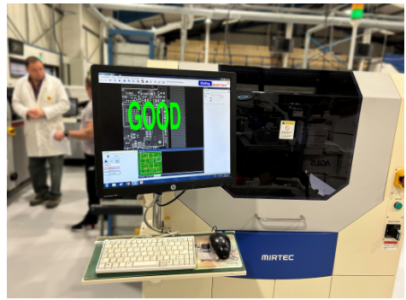
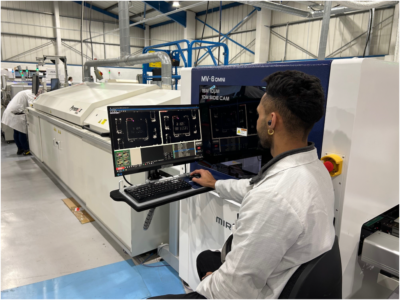
For surface mount technology (SMT), we use inline 3D Solder Paste Inspection (SPI) and 3D Automated Optical Inspection (AOI) to identify potential issues during production.
3D SPI checks the shape, height, area and volume of solder paste deposits before components are placed. This helps identify problems with the paste application that could otherwise lead to soldering defects later in the process.
Following component placement, 3D AOI checks for issues such as incorrect or missing components, misalignment, lifted packages and solder defects. By assessing component height and other three-dimensional characteristics, the technology can identify issues that may not be apparent through conventional two-dimensional inspection alone.
Together, these inspection stages provide valuable real-time information about the manufacturing process, helping ADAPT refine process settings and address potential problems early, when corrective action is more practical.
Inspection and testing work together
Inspection is one part of a comprehensive quality strategy. Depending on the product and its requirements, we can also undertake functional testing, in-circuit testing, boundary scan and automated testing using LabVIEW equipment. Environmental and burn-in testing are available where required.
The right approach depends on the product’s complexity and the level of verification needed. We work with customers to establish suitable test coverage, including testing at sub-assembly stage and before and after potting or encapsulation where applicable.
Testing at appropriate stages helps verify that assemblies meet their requirements as they progress through production. Test results can also be recorded and stored as part of the product’s data record where required, supporting traceability.
A continuous focus on quality
ADAPT’s quality management systems, supported by ISO 9001 and ISO 13485 certification, provide a framework for maintaining consistent standards throughout production. Together with inspection and testing tailored to each product, these processes help us get quality right from the start and deliver assemblies that meet our customers’ requirements.
To discuss your product’s manufacturing and testing requirements, contact ADAPT ems at [email protected] or call 0345 868 2400.